
Dennis Okafor, Senior Health and Science Editor.
It happens at the bathroom mirror around 2 p.m., usually after coffee and before lunch, when you notice the color has migrated to the rim of your mug and your lips look like you have not worn anything at all. You go home, dig through a drawer with eleven half-used tubes in it, and type some version of the same question into your phone: why does long-wear lipstick never actually last. The honest answer is that most of what is printed on the box, from the hour count to the word “transfer-proof,” is tested under conditions that do not resemble eating a sandwich or drinking iced tea. One useful fact before anything else: the pigments that hold longest are the ones that bond to the surface protein of your lips rather than sitting on top of them in a film, and you can often tell which type you are holding just by how it feels going on. This guide walks through what genuinely determines wear time, what is packaging language, and how to test a formula yourself before you have committed a full afternoon to it.
- Dry-down time predicts transfer resistance better than any label claim, so watch the first 90 seconds after application rather than trusting the box.
- Feathering and fading come from two different causes, one mechanical and one chemical, and they need different fixes.
- A five-minute home test beats any counter demo, because your own lip chemistry and habits are the real variable.
What “Long-wear” Actually Means At The Chemical Level
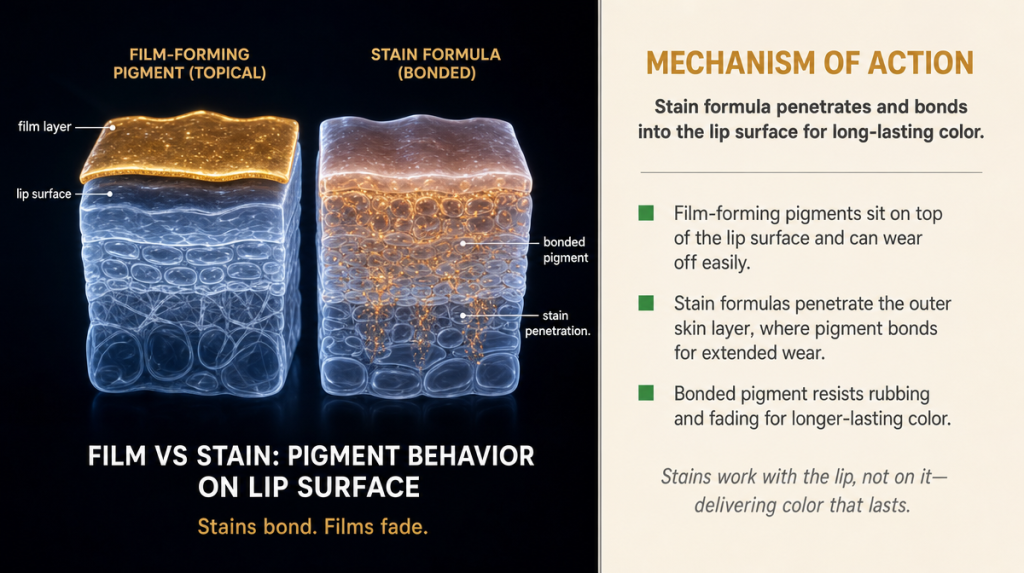
Liquid lipsticks that claim all-day wear generally rely on one of two mechanisms. The first is a volatile solvent, often a silicone or alcohol derivative, that evaporates after application and leaves behind a thin, flexible pigment film. The second is a true stain, where dye molecules bond briefly with the outer layer of lip skin the way a highlighter bonds to paper fiber rather than resting on the surface.
“The film-forming formulas tend to feel heavier going on and can crack if the lips move a lot before the solvent fully evaporates,” said Dr. James Morrison, PhD, a biochemist whose research background is in dermal delivery and formulation science. “Stains behave differently. They fade evenly because the color is bonded, not sitting on top, but they rarely hit the pure, opaque color the film formulas give you.”
Neither approach is inherently better. A film formula gives truer color payoff and is easier to reapply cleanly. A stain formula tolerates eating and drinking with less visible damage but will not photograph as richly saturated. Reading the ingredient list for dimethicone or cyclopentasiloxane near the top generally signals a film former. A short list built around dyes and glycols usually signals a stain base.
The 90-Second Dry-down Test
Most of what separates a lipstick that survives lunch from one that does not happens in the first 90 seconds after you apply it, not over the following eight hours. This is the window where excess solvent evaporates and the pigment sets.
Here is a simple self-test you can do at a counter or at home. Apply a thin coat to the back of your hand, where skin texture is closer to lip skin than the inside of your wrist. Press a tissue against it after 30 seconds, then again at 60 and 90 seconds. If color transfers heavily past the one-minute mark, the formula is still wet and will transfer onto glasses, masks, and collars for longer than advertised. If almost nothing transfers by 60 seconds, you are likely looking at a genuine long-wear formula.
The common mistake is judging a lipstick in the store by how it looks the instant it goes on. Wet-look shine at application tells you almost nothing about performance three hours later. Wait out the full dry-down before deciding, even if that means standing at the counter a little longer than feels natural.
Feathering Versus Fading: Two Different Failures
When a liquid lipstick fails, it usually fails in one of two distinct ways, and knowing which one you are dealing with changes what you should buy next.
Feathering is mechanical. Color creeps into the fine lines around the mouth, usually within the first hour, because the formula is too fluid to hold its edge before it sets. This tends to get worse with dry, dehydrated lips, since product has more surface texture to travel along.
Fading is chemical and behavioral. The color wears down evenly from the center outward, from friction and from the natural oils and enzymes in saliva breaking down pigment over several hours.
“Feathering is largely a hydration and edge-control problem, so a lip liner or a thin balm underneath the color often solves it,” said Dr. Claire Dubois, MD, a board-certified dermatologist. “Fading is closer to normal wear and tends to respond better to reapplication technique than to switching products entirely.”
If your main complaint is lipstick migrating into lines, look at your lip prep before blaming the formula. If your complaint is color simply disappearing by midafternoon, the fix is usually in how and when you touch it up, not which tube you are using.
Reading An Ingredient List Without A Chemistry Degree
You do not need to memorize compound names to judge a formula, but a few categories are worth recognizing.
Silicones, listed as dimethicone or various “-cone” endings, create the smooth glide and help the color set into a flexible film. They are not inherently drying, contrary to some drugstore lore, though heavy concentrations can feel occlusive on already dry lips.
Waxes, such as candelilla or beeswax derivatives, add structure and help the product hold shape in the tube and resist feathering. A formula with almost no wax listed is more likely to migrate.
Humectants like glycerin or hyaluronic acid pull moisture to the lip surface, which sounds purely positive but can, in very humid weather, slightly loosen a film formula’s grip. This is one reason the same lipstick can behave differently on a humid August day on the East Coast than during a dry January indoors with the heat running.
The marketing language to discount almost entirely: words like “infused,” “enriched,” or “complex” attached to a single vitamin or oil near the bottom of an ingredient list. At that position in the list, the amount present is usually too small to meaningfully affect wear or hydration, whatever the front of the box implies.
Why Humidity And Heat Change How Your Lipstick Performs
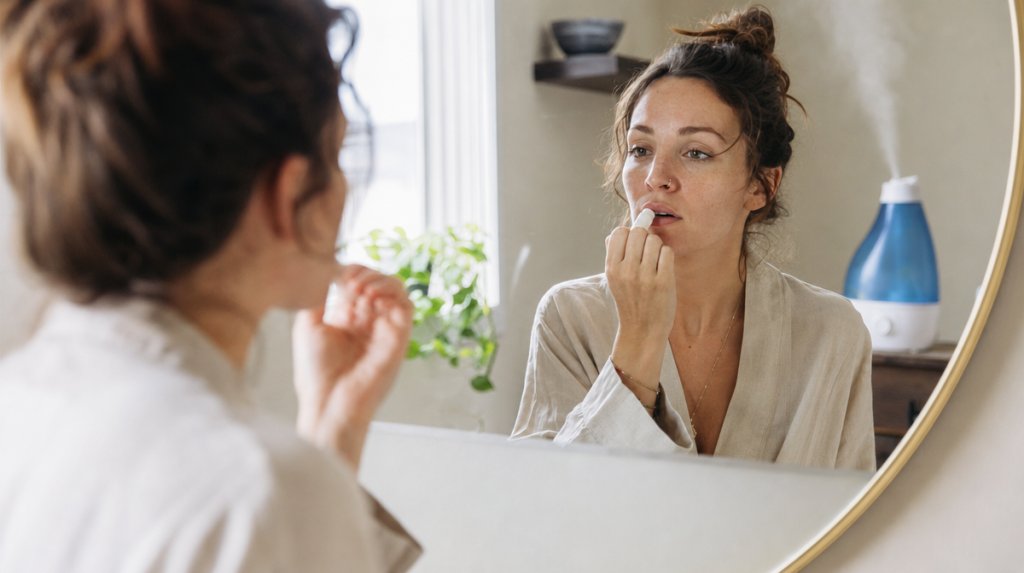
Climate is one of the most underrated variables in lipstick performance, and it is entirely outside the formula itself.
Humid summer air, common along much of the East Coast, keeps lip skin slightly more hydrated and can soften a film-forming lipstick’s set, leading to faster transfer even from a product that tested well in a dry lab. Dry winter air, especially indoors with heating running, pulls moisture from lip skin and makes any formula more prone to feathering into fine lines, since dehydrated skin has more texture for pigment to travel through.
This is why a lipstick that felt bulletproof in October can behave differently in July, and it is not a sign the product changed. Adjusting your lip prep seasonally, using a slightly richer balm before applying color in winter and a lighter one in summer, does more to stabilize wear time than switching formulas every season.
Finding Your Undertone In Daylight
Undertone confusion is behind a large share of lipstick returns, according to consumer behavior data cited by beauty retailers, and it is almost always a lighting problem rather than a color problem.
Store lighting, especially fluorescent overhead lighting, tends to wash out warmth and can make a color look more neutral or cool than it truly is. The only reliable way to judge a shade is in daylight, ideally near a window, with no color filter from a phone camera involved.
A quick self-test: swatch the color on your inner wrist and step near a window. If the shade looks orange or brick-toned against your skin, you likely lean warm. If it looks slightly blue or mauve, you likely lean cool. If it looks true to the tube in both lighting conditions, you are probably neutral.
Shade ranges described as fair, light, medium, tan, and deep are a reasonable starting filter, but undertone within any of those ranges varies enormously. Two people with medium skin can need very different lipstick bases depending on whether their undertone runs golden or rosy.
What Editors And Dermatologists Actually Mean By “Non-drying”
“Non-drying” is one of the most overused phrases on liquid lipstick packaging, and it rarely means what shoppers assume.
“Almost every long-wear formula will feel somewhat drying over many hours simply because film-forming ingredients are designed to stay put rather than move or absorb,” said Professor Margareta Lindberg, MD, PhD, whose research has covered skin barrier function. “A formula marketed as non-drying usually means it dries less than a comparable product in the same category, not that it hydrates the lips the way a balm would.”
A practical way to judge this yourself is to wear a formula for four to six hours, then remove it completely and look at your bare lips in good light. Fine, dry-looking texture or visible flaking suggests the formula pulled more moisture than it claims to. Smooth, slightly matte but not textured skin suggests the claim holds up reasonably well.
The genuinely useful habit, regardless of formula, is applying a hydrating balm underneath and letting it fully absorb before color goes on. This single step affects comfort and feathering resistance more than almost any ingredient swap.
When To Reapply, And How, Without Starting Over
Most long-wear formulas are not designed to survive a full meal without any touch-up, whatever the box implies. Dermatologists generally suggest thinking in terms of partial refresh rather than full reapplication.
Blot lightly with a tissue rather than wiping, which removes excess oil from eating without stripping the base color entirely. Then apply a thin second coat only to the center of the lips, where friction from eating and drinking wears fastest, rather than redoing the entire lip.
The common mistake is reapplying a full, heavy layer on top of a partially worn base, which tends to look patchy and can emphasize any feathering that has already started. A thin, targeted touch-up almost always looks cleaner than a full second application.
Key Takeaways
A long-wear claim on the box tells you very little on its own. What matters is the mechanism behind it, film-forming or stain-based, how the formula behaves in the first 90 seconds after application, and how your own lip hydration and local climate interact with it. Feathering and fading are different problems with different fixes. The most reliable judge of any formula is a short test on your own skin, not the swatch under counter lighting.
A Quick Checklist Before You Buy
- Swatch and wait a full 90 seconds before judging dry-down
- Test the shade in daylight near a window, not under store lighting
- Check whether your issue is feathering (lip prep problem) or fading (reapplication problem)
- Skim the ingredient list for silicones and waxes near the top rather than trusting front-of-box claims
- Apply a hydrating balm and let it absorb before color, especially in dry winter months
- Blot and touch up the center of the lips rather than reapplying the full look
Sources
1. American Academy of Dermatology, public guidance on lip care and dry skin, 2024
2. U.S. Food and Drug Administration, cosmetic labeling guidance, accessed 2026
3. Good Housekeeping Institute, published beauty lab testing methodology notes, 2023
Professor Margareta Lindberg, MD, PhD, Dermatologist and researcher with extensive experience studying skin aging, barrier function, and connective tissue.
Dr. James Morrison, PhD, Biochemist with a research background in dermal delivery and formulation science.
Dr. Claire Dubois, MD, Board-certified dermatologist with experience in cosmetic dermatology and clinical research.
This article is for general information and does not replace individualized advice from a dermatologist.
Results and wear time vary by individual skin chemistry, climate, and habits.