
Priya Shah, Staff Writer. Medically reviewed by Professor Margareta Lindberg, MD, PhD, Dermatologist and researcher
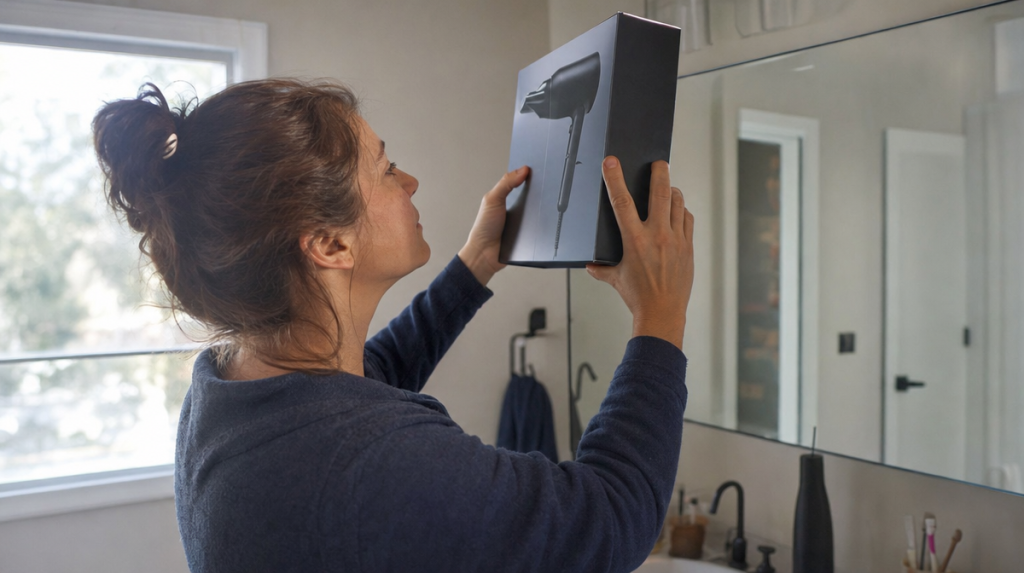
You are standing in the drugstore aisle, dryer box in hand, reading the word “ionic” printed in silver letters and wondering if it means anything at all. Your last dryer left your ends frizzy by the time you got to work. The one before that took twenty minutes just to get your roots dry and left your scalp feeling scorched. So you type the question into your phone right there in the aisle: does ionic actually do anything, or is it just a sticker.
Here is one fact worth knowing before you read further: ionic technology does not change how hot a dryer gets. It changes how fast water leaves your hair, which is a different problem than heat, and it is the reason two dryers with identical wattage can leave your hair looking completely different by the time it is dry.
This guide walks through what dermatologists and biochemists who study hair and scalp actually look at when they evaluate a hair dryer, so that the next time you are standing in that aisle, you know what you are reading.
- Ionic output reduces frizz by breaking up water droplets, not by adding heat control, so a dryer can be labeled ionic and still overheat the scalp if you hold it too close.
- Distance and motion matter more than any setting on the dial, because concentrated heat on one spot of the scalp for more than a few seconds is what causes visible damage, according to dermatology researchers.
- A self-test with a strand of hair and a mirror tells you more than any marketing claim, letting you judge shine and frizz reduction for yourself in under two minutes.
What “Ionic” Actually Means, In Plain Terms
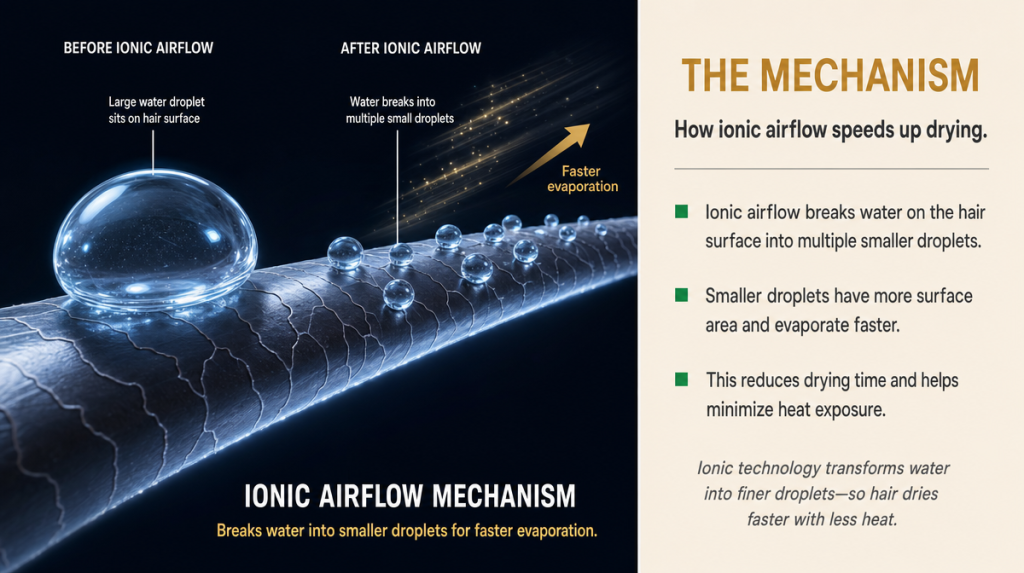
Ionic dryers release negatively charged ions into the airstream. Water droplets on wet hair tend to carry a slight positive charge, and when they meet the negative ions coming off the dryer, they break apart into smaller droplets that evaporate faster.
Think of it the way a fine mist from a spray bottle dries faster on a countertop than a single dripped puddle. Same amount of water, more surface area exposed to air, faster evaporation. That is the entire mechanism. It has nothing to do with temperature.
“The ionic effect is a physical one, not a thermal one,” said Dr. James Morrison, PhD, Biochemist. “It changes the size of the water droplets on the hair shaft. It does not lower the heat coming out of the machine, and consumers sometimes assume the opposite.”
This distinction matters because a dryer can be genuinely effective at reducing frizz through ionic output while still running hot enough to injure the scalp if it is held too close or too long. The two features are independent, and a smart buyer evaluates them separately.
Reading The Wattage Number Without Being Fooled By It
Wattage tells you how much power the motor can draw, which roughly correlates with airflow speed and drying time. It says almost nothing about heat control at the nozzle, which is the number that actually matters for scalp and hair health.
A 1,875-watt dryer with poor heat regulation can do more damage in five minutes than a 1,600-watt dryer with a well-engineered heat sensor. Higher wattage moves air faster, which can shorten your drying time, but faster is not automatically safer.
What to check instead: whether the dryer lists a specific heat setting count (two or three, ideally with a clearly marked cool-shot button) and whether it mentions any kind of temperature sensor or thermostat in the airflow path. These features regulate the actual variable that affects your hair and scalp.
A mistake many buyers make is assuming that a higher number on the box always means a better dryer. It means a stronger motor. Ask what is regulating the heat that motor produces before you decide the wattage is the story.
The Mechanism Behind Frizz, And Why Some Dryers Make It Worse
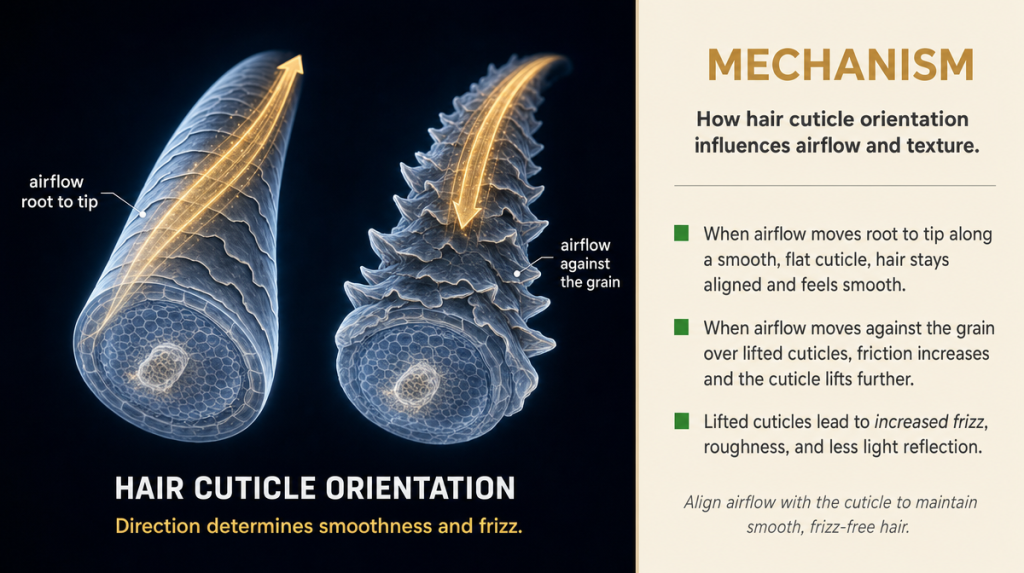
Hair frizzes when the outer layer, called the cuticle, lifts away from the hair shaft instead of lying flat. A lifted cuticle scatters light instead of reflecting it, which is why frizzy hair looks dull even when it is clean.
Heat and rough airflow both lift the cuticle. Cold water and smooth, directional airflow help it lie flat. This is the entire physical basis for why some dryers leave hair shinier than others, independent of any ingredient or coating claim on the box.
“Cuticle behavior is largely mechanical,” said Professor Margareta Lindberg, MD, PhD, Dermatologist and researcher. “Excess heat applied unevenly, or air blown against the direction of hair growth, will visibly roughen the cuticle surface over repeated use.”
The practical version: hold the dryer so air flows from root to tip, following the direction the cuticle naturally lies, rather than blasting it from underneath or sideways. This single habit change often does more for frizz than switching dryers entirely.
Where Cheap Dryers Actually Cut Corners
The corners that get cut in a budget dryer are rarely visible on the box. The most common one is the absence of a real thermostat, meaning the heating coil cycles on and off less precisely, so the airstream can spike several degrees hotter than the dial suggests for a few seconds at a time.
Another common shortcut is a plastic rather than ceramic or tourmaline-coated barrel around the heating element. The coating itself does not dry hair faster, but it distributes heat more evenly across the airflow, which reduces hot spots.
A third is motor durability. Cheaper motors lose airflow speed as they heat up over a drying session, which means the last few minutes of drying a long-haired session can involve more direct heat exposure per minute simply because the air is moving slower.
None of these shortcuts are dangerous in isolation. Stacked together, on a dryer used daily, they add up to more cumulative heat exposure over a year than a better-regulated model, according to biochemists who study formulation and material interactions with hair fiber.
What Realistic Drying Results Look Like, And How Fast To Expect Them
For medium-length, medium-density hair, a well-functioning dryer with genuine ionic output should visibly reduce frizz and flyaways within the first two to three minutes of use, compared to air drying the same hair type.
Shine improvement is more gradual. It typically becomes noticeable after several uses, not the first one, because cuticle smoothing is cumulative and small amounts of damage from previous heat styling do not reverse overnight.
Drying time itself depends heavily on hair thickness and starting wetness, so comparing your dryer’s speed to a friend’s is rarely useful unless your hair type and length genuinely match. A more reliable personal benchmark is timing your own hair on the same setting, at the same wetness level, once a week for a month, then noting whether that number changes as you replace an old dryer or filter.
Results may vary by hair porosity, texture, and how much heat styling the hair has already been exposed to. A dermatologist evaluating hair health typically looks at three cycles of wash and dry, not one, before drawing conclusions about a tool’s real effect.
What Matters Versus What Is Marketing Language
Certain words on hair dryer packaging describe genuine mechanisms. Others describe almost nothing measurable. Knowing the difference saves both money and disappointment.
“Ionic” and “tourmaline” describe real, testable physical properties, the ion output and the mineral coating on the heating barrel, respectively. “Salon-grade” and “professional strength” describe nothing standardized. No regulatory body defines what qualifies a dryer as salon grade.
“Ceramic heating element” is verifiable and meaningful for even heat distribution. “Anti-frizz technology” without further specification usually just means ionic output rebranded, and is worth asking the retailer or checking the specification sheet to confirm.
A useful habit: whenever a claim on the box cannot be traced to a specific physical component (a coating, a sensor, an ion generator), treat it as a marketing phrase rather than a technical spec. This single filter eliminates most of the noise on a typical drugstore shelf.
A Two-minute Self-test You Can Do In The Store Or At Home
Before buying, or on a dryer you already own, take one section of hair near your part, about an inch wide, and dry it alone for thirty seconds on medium heat, holding the nozzle six inches away and moving it root to tip continuously.
Then look at that section under a bright light, ideally daylight from a window rather than overhead bathroom lighting, which flattens shine and can hide frizz. Compare it to an unfilled section nearby.
A dryer performing well should leave that test section visibly smoother and shinier than the untreated hair around it, with minimal static lift at the roots. If the tested section looks rougher, duller, or shows visible flyaways standing up from static, that is a sign of weak or absent ionic output, regardless of what the box claims.
Run this same test on your scalp skin too: after drying, the scalp should feel warm, not hot to the touch. If it feels uncomfortably hot after thirty seconds at medium heat and six inches of distance, the thermostat regulation may be inconsistent, an issue dermatologists say is worth taking seriously for anyone who dries their hair daily.
Key Takeaways
Ionic output changes drying speed and frizz through droplet size, not through heat control. Wattage measures motor power, not safety. Cuticle direction during drying affects shine more than most settings on the dial. Shortcuts in cheap dryers, an absent thermostat, uncoated barrels, weakening motors, add up over months of daily use. The two-minute strand test tells you more about a dryer’s real performance than any word printed on its box.
A Quick Checklist For The Aisle
- Confirm ionic output is mentioned specifically, not implied by an unrelated word
- Look for a stated number of heat settings and a cool-shot button
- Check for any mention of a thermostat or heat sensor
- Note the barrel material: ceramic or tourmaline-coated distributes heat more evenly than bare plastic
- Run the thirty-second strand test in daylight before deciding
- Dry root to tip, six inches away, and check that your scalp feels warm, never hot
Sources
1. American Academy of Dermatology, public guidance on heat styling and hair damage prevention, 2024
2. Mayo Clinic, patient education materials on scalp and hair care, 2023
3. Journal of Cosmetic Science, studies on ionic airflow and cuticle hydration behavior, 2021
Professor Margareta Lindberg, MD, PhD, Dermatologist and researcher with extensive experience studying skin aging, barrier function, and connective tissue, including clinical research and collaborations involving topical skincare formulations.
Dr. James Morrison, PhD, Biochemist with a research background in dermal delivery and formulation science, focused on how topical ingredients interact with and penetrate the skin barrier, including laboratory testing of cosmetic and pharmaceutical formulations.
Dr. Claire Dubois, MD, Board-certified dermatologist with experience in cosmetic dermatology and clinical research, with interests in skin aging, pigmentation, and non-invasive aesthetic treatments.
This article is for general information and does not replace individualized medical or dermatologic advice.
Individual results vary by hair type, texture, and existing heat damage.