
Rachel Doyle, Beauty Editor.
You are standing at the bathroom mirror with the wand halfway to your lashes, trying to remember why yesterday’s coat looked full at 8 a.m. and spidery by noon. On the shelf behind you sit three half-used tubes of “volumizing” mascara, each promising the same thing the last one did. The question you actually type into your phone later is not “best mascara” but something closer to “why does my mascara clump” or “why does my mascara flake off by lunch.”
Here is the useful fact most people never hear: a volumizing formula does its real work in the first three strokes. After that, you are usually adding bulk your lashes cannot support, not more volume. Understanding that single mechanism changes almost everything about how you should be applying it, and it is where this guide starts.
- Less product, applied earlier in the routine, builds more volume than a heavy final coat added after everything has dried.
- Most clumping is caused by air and buildup on the wand, not by the formula itself, and it is fixed by how you pump and wipe the brush, not by switching mascaras.
- Curling, drying time between coats, and how you remove mascara at night affect lash health and next-day volume as much as the product you choose.
Why Your Mascara Clumps By Midday
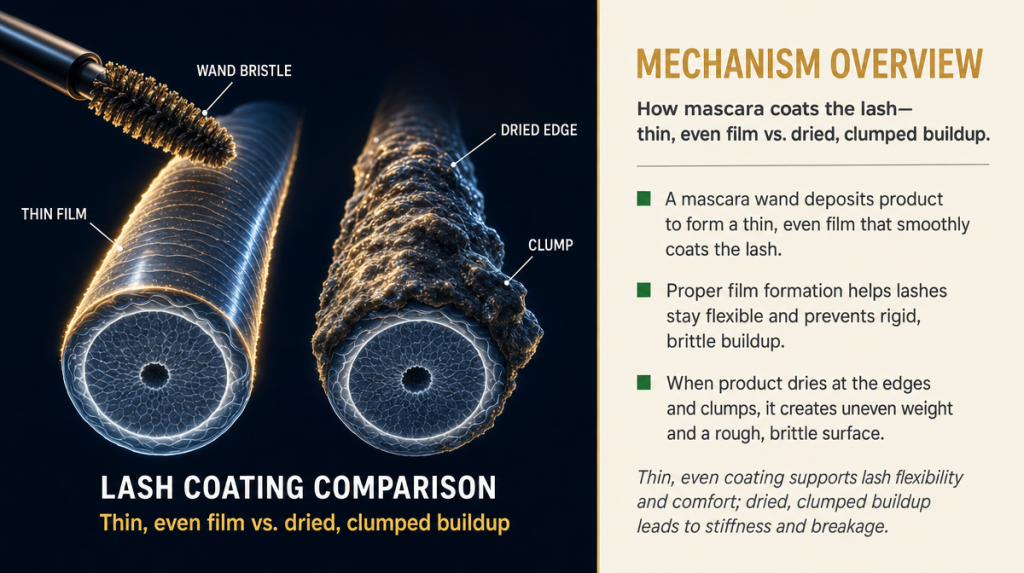
Clumping usually has little to do with the formula sitting in the tube. It has to do with what has built up on the wand itself.
Think of a paintbrush left standing in a can of paint. The first strokes out of a fresh can go on smooth. After a few dips, dried flecks form at the base of the bristles and drag across the canvas. A mascara wand behaves the same way. Each time it goes back into the tube, a thin layer of formula dries on the bristles near the cap. On the next pass across your lashes, that dried layer breaks off in small clumps.
The fix is mechanical, not a new product. Before the wand touches your lashes, wipe one side against the inner rim of the tube. This removes the dried edge and leaves an even, thinner layer of fresh formula on the bristles, which is what actually coats each lash smoothly.
A simple self-test: hold the wand up to the light after your usual pump. If you can see dried, crusted bits clinging near the base of the bristles, that is what is landing on your lashes as clumps, not a flaw in the mascara’s chemistry.
Apply in short, upward wiggling strokes from root to tip rather than one long drag. The wiggle helps separate lashes as the product goes on, so less clumping happens in the first place, and you need fewer corrective strokes later.
The Pumping Habit That Dries Out Your Tube Early
Pumping the wand in and out of the tube several times before each use feels like it is loading up the brush. It is actually pushing air into the tube.
Mascara formulas are suspensions of wax, pigment, and polymers in a solvent base. Once air gets in repeatedly, that solvent evaporates faster, and the formula thickens and dries out well before the expiration date printed on the box.
“Every pump you see pushing air down into the tube is air that has to come back out, and it carries solvent vapor with it,” said Dr. James Morrison, PhD, Biochemist. “A mascara that should last twelve weeks can dry out in five or six simply from repeated pumping.”
Instead, twist the wand gently as you withdraw it, without plunging it up and down. This coats the bristles using the mascara already near the tube’s opening, without forcing new air down into the reservoir.
If a formula has already started to thicken and drag, a few drops of saline eye solution can loosen it temporarily, though the American Academy of Dermatology has noted that stretching mascara past its intended lifespan raises the risk of eye irritation and bacterial growth. When a formula turns stringy or smells different than it did when new, it is time to replace it rather than revive it.
Curl First, Then Coat, Never The Other Way Around
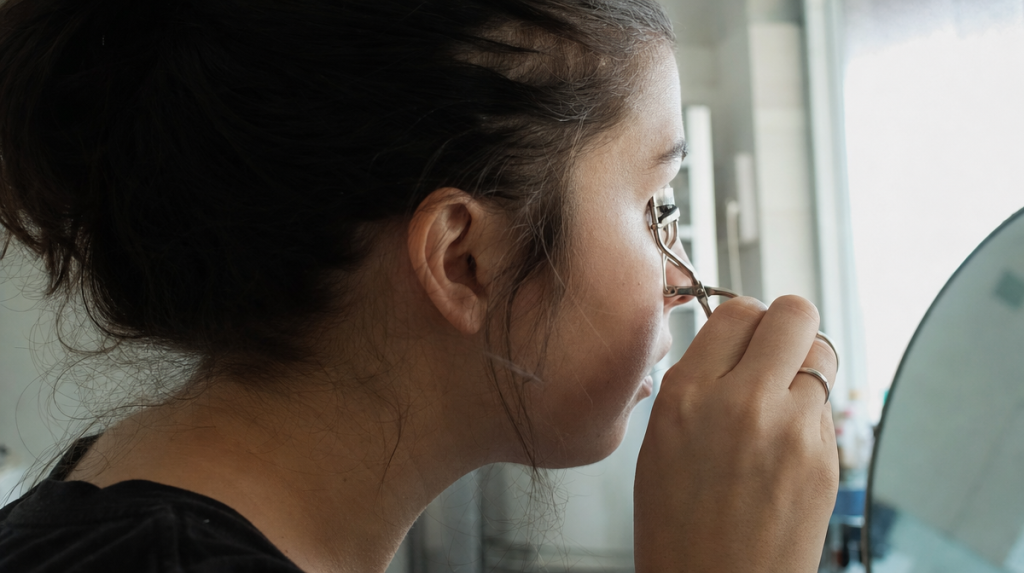
The order of your routine matters more than most people realize. Curling lashes after mascara has already dried can crack the coating and, over time, snap individual lashes at the point of the curl.
Curl lashes on bare, dry lashes first, holding the curler for about ten seconds at the base and then again mid-length for a natural arc rather than a sharp bend. Only then apply mascara.
A volumizing formula applied to a lash that is already curled has more surface to grip and holds the curl through the day, rather than weighing a straight lash down flat. Applying mascara first and curling afterward does the opposite: the curler grips a stiffened, coated lash and can pull several lashes out at once.
If your lashes tend to drop by afternoon regardless, the issue is usually not the mascara’s hold but a curl that was never set on dry lashes to begin with. Heated eyelash curlers, used briefly and on completely dry lashes, tend to hold longer through humid days than a standard curler alone, though they should never be used on wet lashes or immediately after applying any lash product.
How Many Coats Is Actually Too Many
One coat defines the lash. A second coat, applied while the first is still slightly tacky, builds real volume by letting the formulas merge into a single, thicker layer. A third coat, applied after the first two have fully dried, mostly adds weight.
That added weight is why lashes look full at 9 a.m. and start drooping, flaking, or leaving small marks under the eyes by early afternoon. Dry mascara does not bond to dry mascara the way wet product bonds to wet product. It sits on top as a separate, brittle layer that flakes off in small pieces.
The practical rule: apply your second coat within about thirty seconds of the first, while both lashes and formula are still slightly damp. If you want more volume after that, wait a full two minutes for the first two coats to set completely before adding a third, and use it only along the outer corners rather than the whole lash line, where extra weight is least noticeable.
A quick self-test at the end of the day: run a clean finger very lightly under your eye. If you pick up flakes rather than a light smudge, you likely applied more coats than your lashes could hold, not too little mascara but too many dry layers stacked on top of each other.
Reading Past The Word “Volumizing” On The Label
The word “volumizing” on a box describes an intended effect, not a regulated ingredient list. What actually creates the effect is a combination of film-forming polymers, waxes, and sometimes short synthetic or natural fibers suspended in the formula.
“Fibers and polymers do two different jobs,” said Dr. James Morrison, PhD, Biochemist. “Polymers form the flexible film that coats and thickens each lash, while fibers, when present, physically extend the tip and can shed if the brush design does not hold them evenly.”
A thicker-looking wand does not guarantee more volume. What matters more is the spacing between bristles: wider spacing near the base tends to deposit more product close to the roots, where most natural volume is perceived, while a denser, tighter brush toward the tip helps separate and define ends without clumping.
Marketing terms like “buildable,” “lash-lifting,” or “24-hour volume” are not standardized claims and can describe very different formulas. What is worth checking on the box, where listed, is whether the formula is ophthalmologist-tested, a designation with more consistent meaning tied to eye-safety testing rather than to how full lashes will look.
Why The Same Mascara Behaves Differently In July And January
Climate changes how a mascara wears, even when nothing about your routine changes. Humid summer air on the East Coast can soften wax-based formulas, which is why a mascara that held all day in April may smudge under the eyes by August. Dry winter air, especially indoors with heating running, pulls moisture out of the same formula and makes it more prone to flaking and stiff, brittle lashes.
“Skin around the eyes is thinner and more reactive to humidity and dry indoor heat than skin elsewhere on the face, and that affects how a topical film like mascara performs and how the eyelid skin underneath tolerates it,” said Professor Margareta Lindberg, MD, PhD, Dermatologist and Researcher.
A practical adjustment: in humid months, look for formulas labeled water-resistant rather than fully waterproof, which tend to hold shape without becoming difficult to remove. In dry winter months, a light coat of an eyelash-safe conditioning serum at night can keep lashes from becoming brittle enough that mascara flakes off them by midday.
Storing mascara in a cool, dry spot rather than a steamy shower caddy also slows the formula’s natural breakdown regardless of season.
Taking It Off Without Taking Your Lashes With It
How mascara comes off matters as much as how it goes on. Rubbing at the eyes with a dry cotton pad or a makeup wipe, especially with a stubborn or waterproof formula, pulls at lashes that are still anchored in the follicle and can weaken the root over months of repeated tugging.
“Lash loss from mechanical stress at the root is common and usually reversible once the habit changes, but it takes weeks to notice the improvement, so people often blame the mascara rather than the removal method,” said Dr. Claire Dubois, MD, Board-Certified Dermatologist.
The better method: soak a cotton pad with a gentle, oil-based remover, press it against closed lashes for about ten seconds, and let the formula loosen before wiping downward in one soft pass. Repeat with a clean section of pad rather than scrubbing the same spot.
Waterproof and heavily fiber-based formulas typically need an oil-based remover to break down fully. Using only a water-based micellar solution on a waterproof formula often means more rubbing to get lashes clean, which defeats the purpose of a gentler removal step. The Mayo Clinic’s general guidance on eye-area skin care recommends avoiding harsh rubbing near the eyes altogether, given how thin that skin is compared with the rest of the face.
Key Takeaways
Volume comes from technique more often than from the tube itself. A clean, buildup-free wand, two coats applied while both are still slightly damp, a curl set before any product goes on, and a gentle oil-based removal at night will outperform simply switching formulas. Season matters too: what holds all day in a dry January will not necessarily survive a humid August afternoon, and adjusting formula weight and water-resistance to the season solves problems that feel, at first, like a mascara failing to perform.
A Quick Checklist Before You Buy Or Reapply
- Wipe the wand against the tube’s rim before every application, rather than pumping it up and down.
- Curl lashes first, on completely dry lashes, then apply mascara.
- Apply a second coat within thirty seconds of the first, while both are still tacky.
- Let coats fully dry before adding a third, and limit it to the outer corners.
- Match formula weight to the season: water-resistant in humid months, conditioning support in dry winter months.
- Remove with an oil-based remover pressed against closed lashes rather than rubbed or scrubbed.
Sources
1. U.S. Food and Drug Administration, “Eye Cosmetic Safety,” cosmetics guidance, 2023
2. American Academy of Dermatology, public guidance on eye makeup and eyelid health, 2022
3. Mayo Clinic, general patient guidance on periorbital skin care, 2021
Professor Margareta Lindberg, MD, PhD, Dermatologist and researcher with extensive experience studying skin aging, barrier function, and connective tissue.
Dr. James Morrison, PhD, Biochemist with a research background in dermal delivery and formulation science.
Dr. Claire Dubois, MD, Board-certified dermatologist with experience in cosmetic dermatology and clinical research.
This article is for general information and does not replace personal medical advice from your dermatologist or physician.
Individual results from any technique or product vary from person to person.